New GCSE Grades Explained - A Complete Guide of 1-9 Grading System


Table of Content
What Are GCSE Grades?
GCSE is the abbreviation for General Certificate of Secondary Education, which is an academic qualification taken by students in England, Northern Ireland and Wales. Students attending this secondary education are graded based on the GCSE grading system. The marking scale includes 9 (highest) to 1 (lowest) grades. It represents how much a learner comprehends each subject taught in school.
However, grade 4 indicates standard pass, while a grade below this means the student has failed to pass the exam. Colleges, employers and Ofqual schools use these scores to identify if a student is prepared to study further. The GCSE grades are explained in a systematic way to help you understand how these grades are awarded and why they are important.
What Are Good GCSE Grades?
Students often wonder what are good GCSE grades? Well, a score above 7 is considered a good score, as it reflects excellent academic performance for the learner. Moreover, students with a GCSE score of 5 or higher are considered average candidates. These grades can help them attain a competitive edge when applying to top-tier universities.
How Do GCSE Grades Work?
You must be wondering what are the grades for GCSE and how they actually work. Here is a complete explanation. GCSE scores are awarded to students based on their academic performance in the final examination or coursework in specific subjects. These papers were scored by expert examiners who work with recognised boards, including AQA, OCR and Pearson Edexcel. Each correct response helps the student in securing a specific mark based on the precision and quality of their answers.
Once the examiner has scored all papers, they calculate the marks of every student to convert them into grades. However, this is not an immediate process because exam boards need time to set precise grade boundaries, which are decided with Ofqual guidance. It is the standard mark required by a student to attain a certain grade, such as 4, 7 or 9.
For instance, the GCSE grades boundaries 2025 for AQA maths were approximately. 91%. It means a student must score 91 to attain a 9 GCSE grade and 68% to secure a 7 GCSE grade.
Also Know: How many marks to pass GCSE English Language?
What Are GCSE Grades 1 To 9 Means?
Now that you are aware of the mechanism of grades for GCSE, it is important to learn what each grade specifically suggests about a student's academic performance. Hence, this section highlights what each score in the GCSE scale means.
Grade 9
Grade 9 is considered the highest score on the GCSE scale, and it represents the remarkable academic performance of a student. If compared to old GCSE grades on the new scale, it is above A*, which demonstrates high learning proficiencies of learners. Many universities find that students with a GCSE grade of 9 are outstanding.
Grades 8-7
Students scoring a GCSE grade of 8 or 7 are considered skilled, indicating their top-tier academic performance in each subject. This score is equal to the A* and A score of the previous marking system. These marks indicate that the student can understand the concepts quickly.
Grades 6-5
A GCSE score between 6 and 5 indicates good performance, which is equal to a B or C grade of the older scoring method. These are significant scores because they are categorised as a notable pass. Also, it is often classified as the minimum requirement GCSE grade for a wide range of vocational courses.
Grade 4
Students in grade 4 show they have only passed the exam and lack strong academic proficiencies. Moreover, if these GCSE grades compared to old scores, then they are equivalent to C. Government authorities consider this to be the minimum requirement that a student should obtain for any employment and apprenticeship opportunities.
Additionally, students who fail to obtain 4 in maths and English are required to study both subjects till the age of 18.
Grades 3-1
Attaining a grade between 3 and 1 shows the student has failed to meet the minimum passing criteria for post-16 academic options. However, such learners can apply for courses that help in developing Functional skills. Students must secure a GCSE grade of 5 or above to continue their further education.
Unclassified (U)
It reflects that a student has failed to meet the basic and minimum standard required to secure grade 1. Students with these scores are considered to have failed, which indicates they need to retake their exam. Also, this grade remains similar in both the new GCSE grades vs old scores. Students can opt for other qualifications if they get a U in any of the subjects, in case they don't want to retake that exam.
|
Grades |
Equivalent To |
|
9 |
High A* |
|
8 |
Low A* or high A grade |
|
7 |
Low A grade |
|
6 |
High B grade |
|
5 |
Low B or high C grade |
|
4 |
Low C grade |
|
3 |
D or high E grade |
|
2 |
Low E or high F grade |
|
1 |
Low F or G grade |
|
U |
U |
New GCSE Grades vs Old GCSE Grades
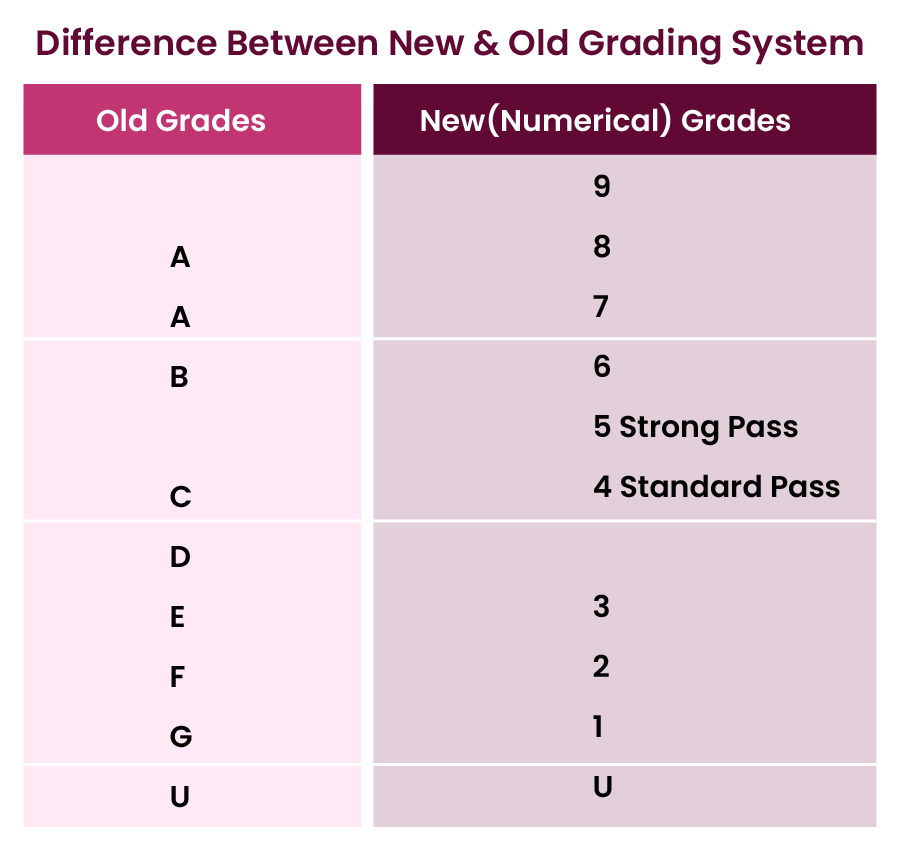
In the preceding section, you saw new GCSE grades explained in great detail. In this section, you will look at the new GCSE grades compared to old grading systems and will be more lucid about the swap that occurred this year. So, let us see what those differences are.
-
The big change that happened is instead of relying on the letters A to G, the system has become numeric. Now, Students receive grades between 1 and 9, with nine being the highest.
-
A grade 4 is equivalent in a broader sense to the predecessor C grade and is considered a pass.
Under the new system, there are six grading points between 4 and 9. However, in the old grading system, there were four grading points between C and A+.
These are the main changes that were introduced in the year 2025. However, there are some similarities also. They are:
1. The base of grade 7 equal to the base of grade A
2. The base of grade 4 equal to the base of grade C
3. The base of grade 1, equivalent to the base of grade G
4. Three number grades - 9, 8 and 7 - are equivalent to the two prior top grades of A* and A.
These are all the differences and similarities between old gcse grades to new grading systems. This is how 1-9 GCSE grades are explained in detail. We hope you understand the changes that occurred in the grading system. If you have a problem, you can check the table shown above.
How to Improve GCSE Grades with Instant Assignment Help?
Students who desire to improve their grades for GCSE should seek guidance from the experts who can help them boost their overall scores. They can find a range of online tutors, including Instant Assignment Help, who are emerging as the most reliable and preferred tutors. Here are a few proven strategies that our expert recommends to enhance your scores:
Understand Exam Format - Firstly, students must understand the curriculum of each subject, pattern and marking criteria. It helps to identify average GCSE grades for each subject that you will need to ace the exam. Also, using this, you can create a precise study plan that helps to cover each aspect of the syllabus.
Identify Strong and Weak Areas Early - Identification of weak and strong areas in advance is considered the most efficient way for improving GCSE grades. For this, you can take mock tests and review results to find areas for improvement. Moreover, you should track repetitive errors to eliminate them and score a good grade.
Create a Realistic Study Plan - Once you are aware of the errors, try to create a personalised study plan by focusing on these areas. It is crucial to create a realistic plan that is obtainable and suits your daily schedule. Remember to add time for rest and regular revisions to avoid burnout when preparing.
Also Take Help From: GCSE Biology Topics
Was This Blog Helpful?


Most Popular Questions Searched By Students
- What Do GCSE Grades Mean?
GCSE grades are a scoring system in England that uses numerical terms ranging from 9, which is the highest, to 1, which is considered the lowest grade. These scores are crucial and act as the primary doorway to further education. - How UK GCSE Grades Explained?
The UK GCSE grades can be explained in simple terms. The grading system has seen some changes this year. The main change that happened is that instead of leaning on the missive A to G, the latest system is numeric. Students acquire a grade from 1-9, with 9 being the highest grade. - Is a 9 In GCSE 90%?
A grade 9, according to the GCSE grading system, is the highest grade but it is not equivalent to a fixed percentage like 90%. It only represents the highest level of academic excellence attained at GCSE.
- What Is the Average GCSE Score In the UK?
The average grade awarded in the UK in the previous year was 4.80. It is most probably the same as the grade prior to the pandemic. Now, due to changes this year, it will fall into the category of standard pass. - What GCSE Grades Are Needed for Oxford?
Students can apply to Oxford University without a minimum GCSE score. However, a grade above 8 is considered competitive to secure admission to Oxford. - What Do GCSE Grades 9-1 Mean for University Entry?
GCSE grades reflect the academic performance of students in their secondary school and can affect their university applications. Students with grades above 7 can easily secure admission in top institutes. Grades between 6 and 3 and 6 show average academic performance of students. Students with a GCSE score below 3 show that they have barely passed the exam and are not competent.





Get 5% Cashback
On App - Grab it while it lasts!

Download app now (or) Scan the QR code



Login / Sign up
Get Your Free Dissertation Outline NOW !Congratulations!
Check Your Registered Mail for download

- Plagiarism
- Pricing
- Order Now
- Call Back